
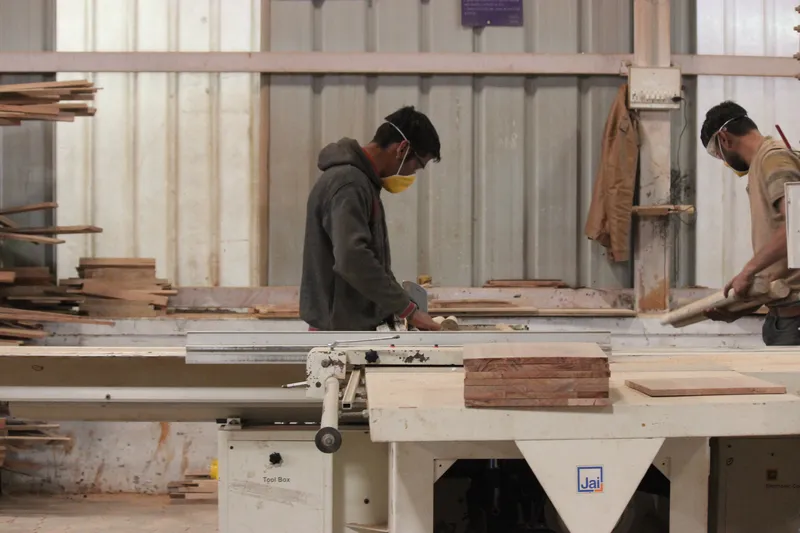
SEDEX Membership & Ethical Trade Compliance
A.J. Craftex is a registered member of SEDEX (Supplier Ethical Data Exchange), the global platform for sharing responsible sourcing data. SEDEX membership requires transparent reporting on labor standards, health and safety conditions, environmental practices, and business ethics across the manufacturing operation.
SEDEX approval certifies that the Jodhpur manufacturing facility has been assessed against internationally recognized ethical trade standards. This includes compliance with regulations governing:
| Compliance Area | Standard Applied | Status |
|---|---|---|
| Labor Standards | ILO Core Conventions | Compliant |
| Working Hours & Wages | Local labor law / ETI Base Code | Compliant |
| Health & Safety | Facility risk assessment protocols | Compliant |
| Environmental Impact | Waste management & emissions standards | Compliant |
| Business Ethics | Anti-bribery & anti-corruption policies | Compliant |
| Child Labor / Forced Labor | Zero-tolerance policy | No Findings |
SEDEX membership is maintained through ongoing data submissions and periodic audit cycles. Buyers sourcing through A.J. Craftex USA can access SEDEX audit data through the platform to satisfy their own responsible sourcing requirements and vendor qualification protocols.
USDA-Compliant Timber Treatment
All solid wood products manufactured by A.J. Craftex are produced from timber that has undergone treatment processes compliant with USDA APHIS (Animal and Plant Health Inspection Service) import regulations for wood packaging and wood products entering the United States.
A.J. Craftex employs a two-stage timber treatment process to ensure all wood materials meet phytosanitary requirements for international shipment:
Stage 1: High-Pressure Chemical Pest Treatment
Raw timber stock is subjected to high-pressure chemical treatment to eliminate wood-boring insects, termites, and other biological agents. This process saturates the wood fiber to a depth sufficient to prevent re-infestation during storage, production, transit, and end-use.
Stage 2: Chamber Seasoning (Kiln Drying)
Following pest treatment, timber is placed in controlled seasoning chambers (kilns) where temperature and humidity are regulated to reduce moisture content to specification levels. Chamber seasoning provides the following benefits:
- Dimensional stability — reduces warping, cracking, and shrinkage in finished goods
- Structural integrity — improves load-bearing performance of joinery
- Finish adhesion — properly seasoned timber accepts stains, lacquers, and protective coatings uniformly
- Phytosanitary compliance — achieves core temperature thresholds required for pest elimination certification
Timber Sourcing Policy
A.J. Craftex maintains a strict policy of using only government-approved and legally sourced timber. All wood materials are procured through documented supply chains with traceable origin records. The company does not source from protected forests, restricted zones, or unauthorized logging operations.
Documentation for timber origin, treatment certificates, and phytosanitary compliance records are maintained for each production lot and are available for buyer inspection upon request.
Quality Control Discipline
Quality assurance is embedded across the full production cycle — from raw material intake through final packaging and container loading. Key QC checkpoints include:
- Incoming timber moisture and treatment verification
- Component dimensional accuracy (CNC-machined tolerances)
- Assembly structural integrity testing
- Surface finish inspection (stain, lacquer, polish uniformity)
- Hardware and fitting verification (KD assembly hardware function)
- Final packaging and labeling audit
- Pre-loading container inspection